Home › How Long Does a Water Heater Last in Hard Water?
How Long Does a Water Heater Last in Hard Water?
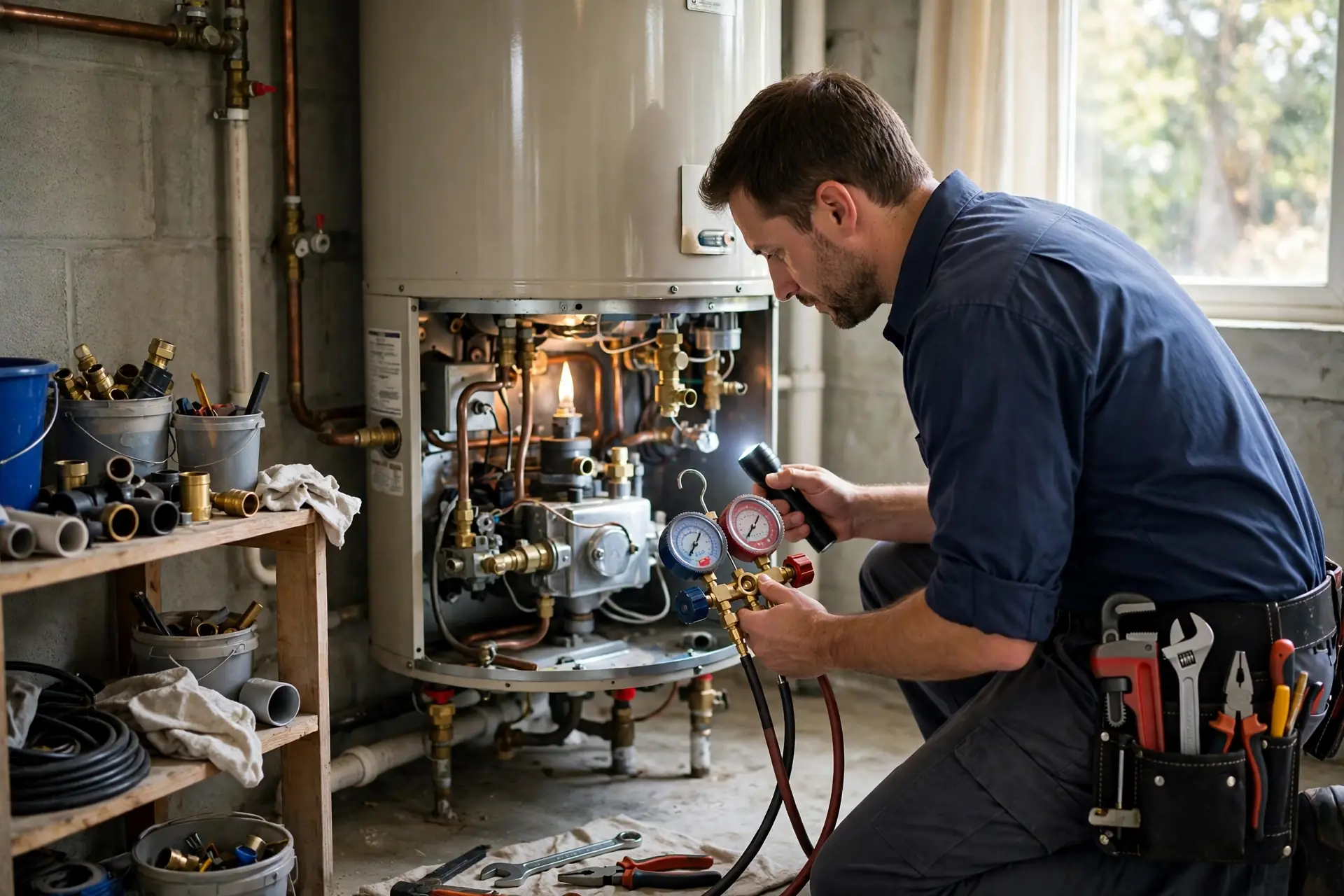
Tank heaters typically last 8–12 years, and hard water pulls toward the short end: sediment bakes onto the bottom, the tank rumbles, efficiency falls. Annual flushing, an anode check around year five, and honest math at repair time — if a repair costs half of replacement on a 10-year-old tank, replacement usually wins.
Questions about your own home? Call (615) 576-1152 — Hartsville Plumber Near You, 108 E McMurry Blvd, Hartsville, TN 37074.
Why Hard Water Shortens a Tank's Life
Hard water is the reason a Hartsville tank rarely reaches the long end of the usual 8 to 12 years. Sediment settles on the bottom of the tank and bakes into a hard layer, so the burner or element has to heat through that layer to warm the water, which wastes energy and makes the tank rumble and pop. The sediment also traps heat against the steel, which wears the tank from the inside, and it coats the anode rod that protects the tank from rust, so once the rod is gone, the tank itself starts to go. Annual flushing clears the loose sediment before it bakes on, and an anode check around year five catches the rod before it is spent. If your tank rumbles, if the hot water runs out faster than it used to, or if the water runs rusty after a trip away, those are the signs the sediment has won.
Household size matters too. A tank that is too small for the family runs out every morning and works at full load all day, which ages it faster, while a tank that is far too big wastes money heating water nobody uses. Our installation page explains how we size a tank to the household, and our cost guide gives typical ranges for a tank replacement.
The Repair-or-Replace Call, in Plain Terms
Use the half rule as a guide: if a repair costs close to half of replacement on a 10-year-old tank, replacement usually wins, because the tank itself is near the end and the next repair is not far behind. On a younger tank, a failed element, thermostat, or gas control is usually worth repairing, because the tank has years left once the part is fixed. A tank that leaks from the bottom is different: that is a tank failure, not a part failure, and it only gets worse, so shut the water and power or gas to the heater if you can do so safely, and call us at (615) 576-1152. Tankless units from Rinnai and Navien follow their own rhythm, with annual descaling in our hard water, and we show you that routine when we install one.
Questions About Water Heater Life
How do I find out how old my water heater is?
Check the manufacturer label on the side of the tank, which usually lists the manufacture date or a serial number that includes it. If the plate is missing or unreadable, tell us the brand and model when you call, and we can help you work it out on the visit.
Does flushing really help, or is it too late once the tank rumbles?
Flushing helps most when it is done every year, before the sediment bakes on. If the tank has rumbled for years, flushing may quiet it some, but thick sediment may not fully clear, and that is when the repair-or-replace conversation starts.
Why does my hot water run out faster than it used to?
Usually sediment has built up on the bottom of the tank, so there is less room for hot water and the heater cannot keep up. A failed element or thermostat can do the same thing, so we test both before deciding whether the tank needs a flush, a part, or a replacement.
Is a tankless heater a good fit for hard water?
Yes, with annual descaling, because tankless units heat water as it flows and scale builds on the heat exchanger fast in hard water. We install Rinnai and Navien units, size them to your household, and show you the descaling routine before we leave.
Water problem in Hartsville? Let's fix it today.
Call for pricing, honest diagnosis and help across Trousdale County — ask about todays availability when you call.
Mon–Fri 7AM–7PM · Sat 8AM–4PM · 24/7 Emergency · 108 E McMurry Blvd, Hartsville, TN 37074